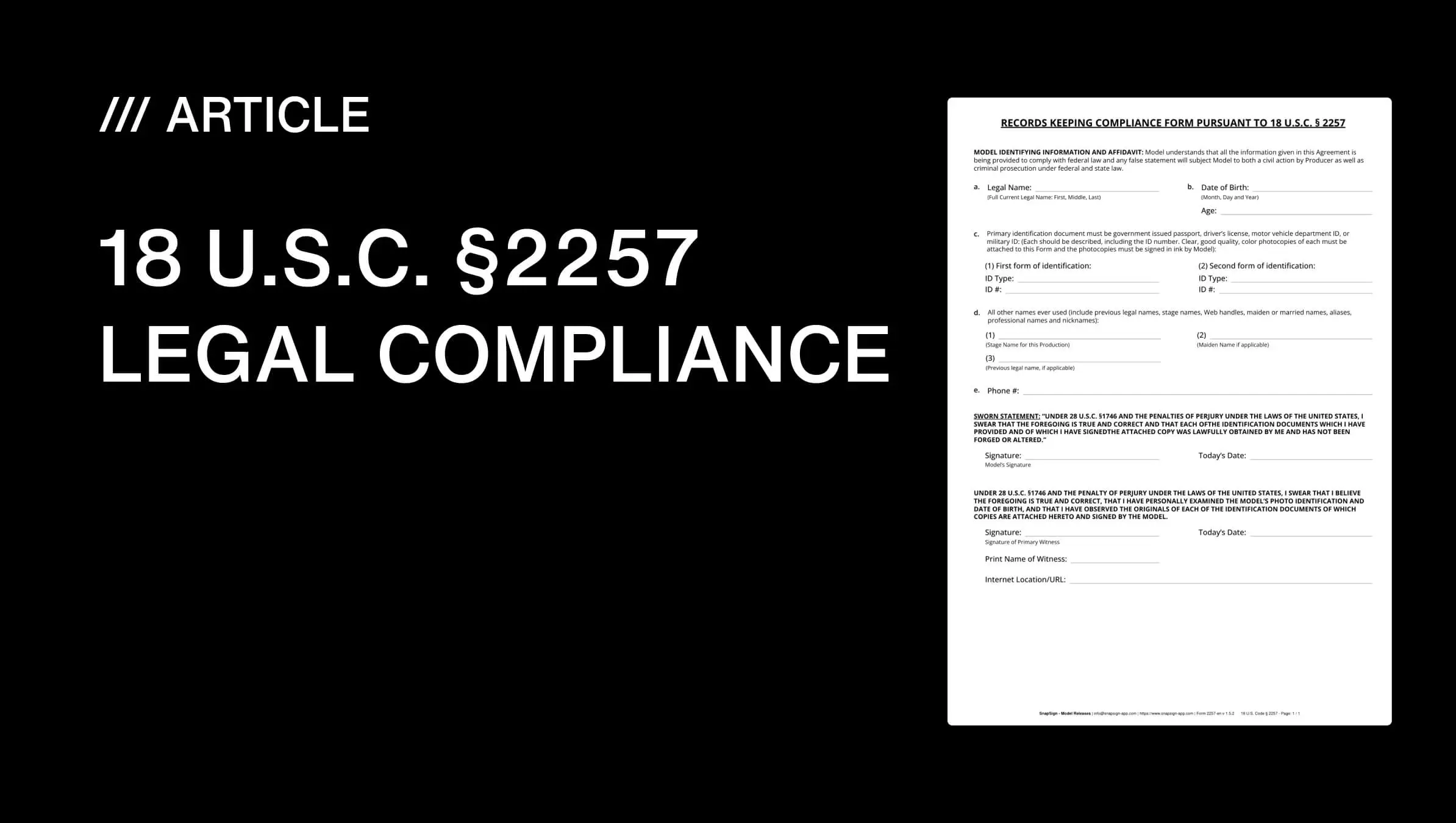
Quick Answer: What 2257 Compliance Requires
📌 OnlyFans creator? This page covers the full 18 USC 2257 legal framework for all content creators. If you're looking for OnlyFans-specific platform rules, age verification steps, collab verification, and ban appeal workflows, read our dedicated guide: OnlyFans Rules & 2257 Requirements — How to Avoid Bans.
18 U.S.C. § 2257 - also written as "2,257" or simply "2257" - is the federal law that requires anyone producing or publishing sexually explicit content in the United States to verify the age and identity of every performer through government-issued photo ID and keep those records organized, segregated from business files, and tamper-proof for the long term. If you create adult content - solo, with collaborators, on OnlyFans, or on your own platform - you are responsible. The penalty for getting it wrong is up to $250,000 in fines and 5 years in prison per violation. Below, we break down the statute section by section, explain who it covers, and walk through exactly how to fill a 2257 form correctly.
18 USC 2257: The Statute, Section by Section
Title 18 USC 2257 - codified as 18 U.S.C. § 2257 and sometimes written as 18 USC section 2257 - is the federal record-keeping law that underpins all adult content compliance in the United States. The statute sits within Title 18 of the U.S. Code (Crimes and Criminal Procedure) and exists alongside related provisions like 18 USC 2251 (sexual exploitation of children) and 18 USC 2257A (record-keeping for simulated explicit content).
USC 2257 was enacted as part of the Child Protection and Obscenity Enforcement Act of 1988 and has been amended several times - most notably by the PROTECT Act of 2003 and the Adam Walsh Child Protection and Safety Act of 2006. Each amendment tightened the record-keeping requirements and expanded the definition of who qualifies as a producer. The current text of 18 USC 2257 requires any person who produces, publishes, or distributes visual depictions of actual sexually explicit conduct to:
- Verify performer age and identity. Examine a government-issued photo ID for every person appearing in the content. The ID must be unexpired on the day of filming.
- Record all names used. Document the performer's legal name, every stage name, alias, maiden name, and nickname used in content - past or present.
- Maintain segregated records. Keep 2257 documentation separate from general business files, organized by production, and accessible for inspection.
- Designate a Custodian of Records. Name a real person - typically yourself - and publicly display their legal name and physical address where the content is published.
- Retain records permanently. The federal floor is 7 years from the production date, or 5 years after you stop producing - whichever comes later - and content that stays online effectively pushes that to indefinite retention.
The penalties for non-compliance under 18 USC 2257 include federal criminal charges, fines up to $250,000 for individuals ($500,000 for organizations), and up to 5 years in prison for first-time violations. Repeat offenses carry harsher sentences. Beyond the criminal exposure, platforms enforce 2257 through content takedowns and account bans - OnlyFans, Fansly, ManyVids, and other platforms terminate accounts that fail to produce 2257 documentation when requested.
Why Trust This Guide
I am a filmmaker. I have sat across from performers with a stack of paper releases, a dying pen, and the creeping awareness that if I lost those papers, I had nothing. The legal language in this guide is precise because 2257 demands precision, but the explanations are grounded in how creators actually work - at home, on set, on a deadline. — Pavel Demidovich, Film Photographer, Filmmaker, Founder of SnapSign
Who the Law Covers - And What It Actually Requires
The statute defines two categories of producer. Both carry the same obligations:
- Primary producer. You filmed or photographed the content. You are responsible for collecting performer IDs, verifying ages, and maintaining records from day one.
- Secondary producer. You published, distributed, edited, or reposted explicit content - even if someone else filmed it. Sharing a clip on your feed, hosting user-submitted material, or re-editing existing footage makes you a secondary producer with full 2257 liability.
A 2257 record and a model release are companion documents, not substitutes for each other. The ID and name history above prove who appeared in the content and that they were of age - the model release proves they consented to being filmed and to how the content would be used. Most creators sign both in the same session.
On r/onlyfansadvice, one of the most consistent sources of confusion is whether posting on OnlyFans or Fansly transfers the legal burden to the platform. It does not. Platforms have their own 2257 obligations, but those do not replace yours. As one Reddit creator put it in a thread about 2257 fears: they were not sure whether the inspection requirement meant "giving someone a blank check to enter my residence." It doesn't - the inspection provision targets commercial studios and distributors, not home-based solo creators - but the fact that creators worry about this shows how poorly the statute is explained in most guides.
The "every name ever used" requirement is another frequent source of anxiety on Reddit. A creator on the same r/onlyfansadvice thread worried that long-forgotten social media accounts could trigger perjury charges. In practice, you need the performer's legal name, current stage names, and any aliases they actively use in content. You are not expected to excavate deleted Myspace profiles. Include what a reasonable person would consider relevant names and have the performer confirm the list is complete.
What You Must Keep - The Full Checklist
The statute requires seven categories of records. Miss one, and you fail an audit. Here is every item, what it means in practice, and the mistakes that trip up creators who learn about 2257 from a Reddit comment instead of the law:
| Requirement | What it means in practice | What gets creators in trouble |
|---|---|---|
| Performer ID | Government-issued photo ID - passport, driver's license, or state/national ID. Front and back. Must be unexpired on the day of filming. | Accepting student IDs, expired documents, or photos of IDs instead of clear scans. "I saw their ID once" is not a record. |
| All names used | Legal name, stage names, aliases, maiden names currently or previously used by the performer in content. | Recording only the stage name. The statute says "every name ever used" - but in practice this means names tied to the adult industry, not every forgotten social account. |
| Date of birth | Documented from the ID. Every performer must be verifiably 18 or older at the time of production. | Verbal confirmation alone. "They told me they were 19" has no legal weight. The date must come from the ID. |
| Production details | Exact date of filming and the location (city and state) where the content was produced. Tied to each performer's records individually. | Grouping multiple shoots under one generic label. Each production needs its own dated documentation. |
| Custodian of Records | A real person's legal name and physical mailing address, publicly displayed where the content is published. This is typically you. | Using a stage name, leaving the field blank on publishing platforms, or using a PO box without a street address for business registrations that require one. |
| Retention period | 7 years from production, or 5 years after you stop producing - whichever is later. Content still online counts as still active, so budget for permanent retention. | Deleting records when a hard drive fails, a phone is lost, or a cloud subscription lapses. Permanent means permanent. |
| Segregated storage | 2257 records must be maintained separately from general business files. They cannot be mixed into a folder with invoices, tax documents, or creative assets. | Dumping everything into one Google Drive folder and calling it done. Regulators expect organized, purpose-maintained records. |
These are not best practices. They are the statutory minimum. An inspector, platform compliance team, or court will ask for these items - potentially years after the shoot, potentially for content you have forgotten you made. The record-keeping does not need to be complicated. It needs to be correct, complete, and survivable.
How to Fill Out a 2257 Form - Step by Step
Most 2257 forms found online are bare PDFs - a blank page with field labels and no instructions. Filling one correctly means understanding what each field demands and what happens if you get it wrong. Here is the exact process, field by field:
| Step | Field | What to enter | Critical detail |
|---|---|---|---|
| 1 | Producer / Custodian of Records | Your full legal name - the person responsible for maintaining the records. This is typically you if you filmed the content. Use the exact name on your government ID. | Cannot be a stage name, business name, or alias. Must be a real person reachable at a physical address. This name appears publicly wherever the content is published. |
| 2 | Custodian mailing address | A physical street address where records can be inspected. PO boxes may not suffice for all platforms - check your publisher's requirements. | This address is publicly displayed. If you work from home and have privacy concerns, use a registered agent service or business address. Do not leave this blank. |
| 3 | Performer legal name | Full legal name exactly as it appears on the performer's government-issued photo ID - including middle names. | Name mismatches are the #1 reason 2257 records fail. Copy the name from the ID character by character. John A. Smith ≠ John Smith. |
| 4 | Date of birth | Verified from the government ID. Format: MM/DD/YYYY. The performer must be 18 or older on the day of filming. | "They told me they were 19" has zero legal weight. The date must come from the ID, and you must have examined the ID yourself. |
| 5 | All names ever used | Stage names, aliases, maiden names, previous legal names - every name the performer has used in adult content, past or present. | Most overlooked field on the form. Ask explicitly: "Have you performed under any other name?" Document the answer. An undiscovered alias can trigger a compliance failure. |
| 6 | ID document details | ID type (passport, driver's license, state ID), ID number, issuing authority, expiration date. Attach clear images of both sides. | ID must be unexpired on the day of filming. Use a flatbed scanner or scanner app - phone photos with glare get rejected. Make sure the expiration date is clearly visible. |
| 7 | Production date and location | Exact date of filming (MM/DD/YYYY) and the city/state where content was produced. Tied to each performer individually. | One form per production, per performer. If you shoot with the same person on three different dates, you need three separate 2257 records - not one form with all three dates. |
| 8 | Depiction description | Brief description of the content - enough to connect the 2257 record to the published material. URL, title, or reference ID of where the content appears. | Vague descriptions ("video shoot") don't help during an audit. Be specific: "Solo scene, 'Morning Light' video, published at example.com/videos/morning-light." |
| 9 | Performer signature and date | The performer signs and dates the form after reviewing that all information is correct. Digital signature with audit trail is preferred over ink. | The signature date must match or be close to the production date. A form signed months before or after the shoot raises red flags during inspection. |
After completing all fields, store the original signed form in segregated storage - separate from invoices, tax documents, and creative assets. That record needs to outlast at least 7 years from the shoot date or 5 years past your last production - whichever stretches longer - and if the content is still live online, treat the retention clock as open-ended.
Download SnapSign's blank 2257 compliance form to see the full template structure - or use the app to create, sign, and store 2257 documents with SHA-256 hashing and a timestamped audit trail.
How SnapSign Handles 2257 - From Template to Audit Trail
We built a dedicated 2257 template - the Model 18 U.S. Code § 2257 participant type - that captures the exact fields the statute requires in a single signing flow. Instead of downloading PDFs from legal websites, filling them in manually, scanning them back, and storing copies in folders you hope survive the next decade, you open the app, select the 2257 template, and work through it.
The template captures every field the statute and platform compliance teams expect:
- Performer identity. Legal name, date of birth, phone number, email - plus stage names, maiden names, previous legal names, and all other nicknames or aliases the performer has used in content.
- ID documentation. Government-issued photo ID - type, ID number, and images of both sides - captured directly in the performer's record.
- Depiction and location. Shoot date, URL or description of the depiction, and location information tied directly to each performer's record.
- Performer initials and signature. The performer reviews the completed form, adds their initials, and signs - in-app or remotely via a secure, tokenized email link with a 48-hour expiry. No app install required on their side.
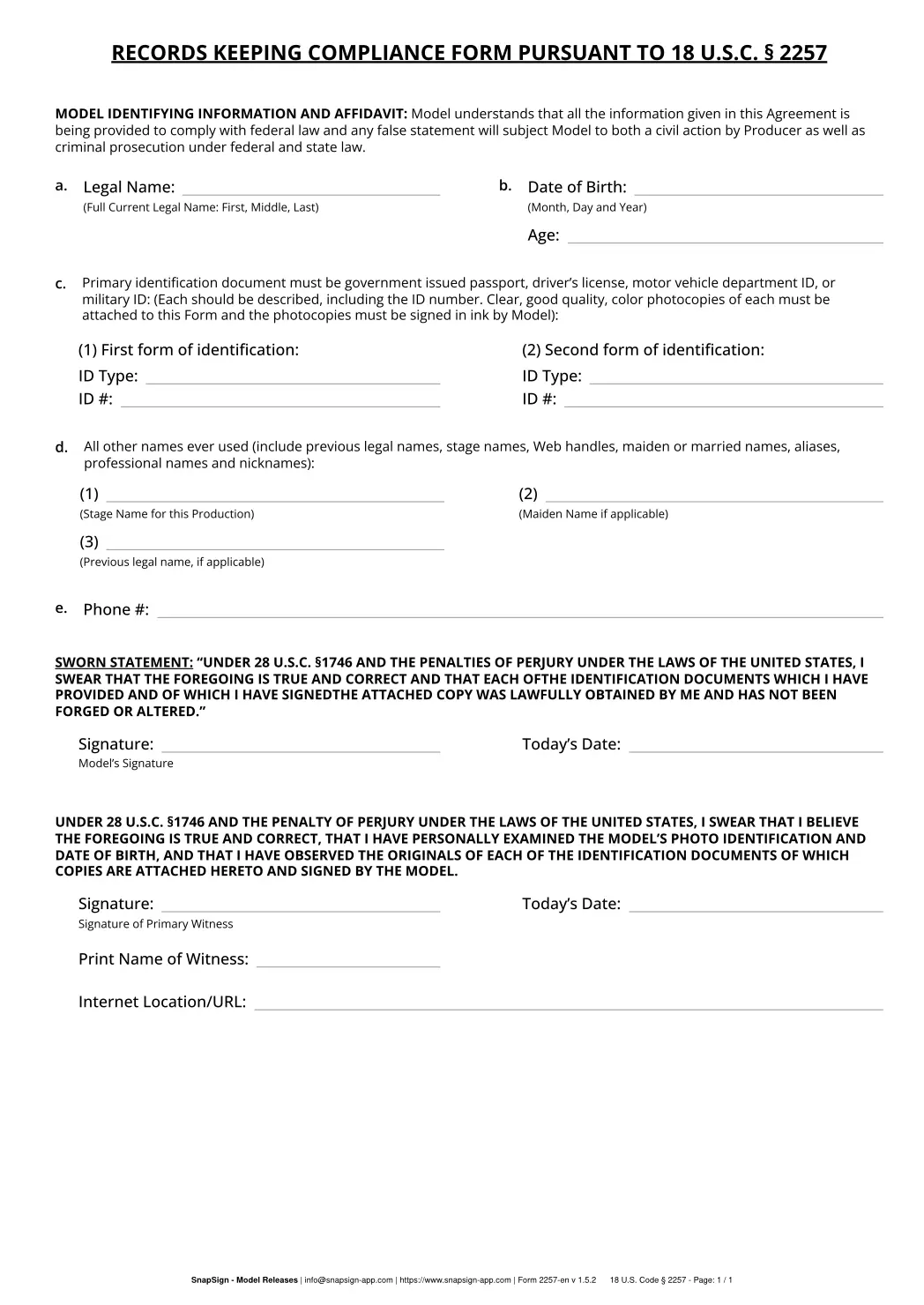
Download a blank 2257 compliance form to see the full template structure.
Every signed contract is SHA-256 hashed and stored with a timestamped audit trail: the signer's email, IP address, and signature time are logged. You can verify any signed 2257 form through our public contract integrity validator. When a platform compliance team asks for 2257 documentation - and this happens, routinely - you can prove the document has not been modified since it was signed. That is the difference between an organized response and a panic.
If you work with repeat performers, the 2257 template integrates with SnapSign's Model Profiles. Save a performer's legal name, date of birth, and aliases to your library once - those fields auto-fill into every future 2257 form. You still capture fresh ID images and signatures per shoot, but the re-typing disappears. For creators who film with the same talent across multiple productions, this turns a 10-minute form into a 2-minute review.
Why a 2257-Specific Tool Beats Patching It Together
Creators handle 2257 four ways - and three of them fail when the compliance team asks for documentation. The fourth approach is what we built SnapSign for:
| Approach | 2257 template? | Audit trail? | Remote signing? | What fails |
|---|---|---|---|---|
| Paper forms + filing cabinet | Varies | No | No | Fire, flood, lost in a move. No chain of custody. A photo of a paper form proves nothing about when it was signed. |
| Downloaded PDF + Google Drive | Depends on the source | No | No | No proof of when or by whom it was signed. PDFs can be edited. Folder structure is up to you - and often forgotten. |
| Generic e-sign (DocuSign, Adobe Sign) | No - you supply the legal text | Yes | Yes | Missing 2257-specific fields: performer aliases, depiction details, custodian structure. You are legally responsible for getting the template wording right - and generic tools do not validate it for you. |
| SnapSign 2257 template | Yes - built to match the statute | Yes | Yes | Does not replace legal advice. We provide the operational layer - you still need a lawyer to confirm your compliance setup fits your specific situation. |
One creator on r/photography described stitching together Google Forms, an automation tool called Portant, DocuSign, and Google Drive - four separate services - just to get one release signed and stored. For 2257, where the stakes are federal criminal liability, four-tool workflows are not a strategy. They are a liability.
What We Cannot Do - And Will Not Pretend Otherwise
SnapSign is not a law firm. We provide the template, the signing infrastructure, the audit trail, and the secure cloud storage. We do not provide legal advice, and no article - including this one - can replace a lawyer who understands your specific situation. 2257 enforcement varies by jurisdiction, the nature of the content, the platform where it is published, whether performers are employees or independent contractors, and whether you operate across state or national borders.
If any of these apply to you - and for most creators, several do - hire a lawyer who knows 18 U.S.C. § 2257. Use SnapSign as the operational layer that keeps your records organized, verifiable, and durable. The paperwork stops being the thing that keeps you up at night. The legality of your specific business structure is between you and your attorney.
For platform-specific compliance strategy, see our guide to avoiding 2257-related bans on OnlyFans. If you work with talent under 18, read about minor model release requirements - a related but distinct legal area with its own rules.
Final verdict - 2257 Compliance
2257 compliance is specific, not complicated. Know who appears in your content. Verify their age with government ID - every person, every shoot. Document the date, location, and nature of the production. Keep those records organized, segregated from your other files, and stored somewhere they cannot be lost, corrupted, or deleted. Name a real Custodian of Records and display that information where your content is published. The creators who get into trouble are rarely the ones who never heard of 2257. They are the ones who knew - and trusted a system that failed: a dead hard drive, a template they downloaded and never verified, an ID they accepted at face value. We built SnapSign's 2257 template to remove that failure point, but the legal judgment calls - jurisdiction, business structure, risk tolerance - remain yours, with your lawyer. The paperwork should be the easy part.